
What to see in Ogliastra beyond the beaches: caves, canyons, nuraghi
by Roberto Demurtas · Host of Villa Pelau · updated on 13 July 2026
What to see in Ogliastra beyond the beaches: Maria Lai's museum, nuraghi, canyons, the Rocce Rosse and starry skies. Tips from a local.
When people talk about what to see in Ogliastra, everyone thinks of the sea first — for very good reason, and I've covered it in the beaches guide. But if you stop at the coast, you miss half the story. This is a land of mountains, millennia-old nuraghi, world-class contemporary art, and completely immersed in nature, far from light pollution, which rewards you with spectacular night skies.
I live here, in Pelau, and in this article I've put together the places I always recommend to my guests when they ask "and beyond the sea?". All of them are within half an hour's drive of the villa.
The places at a glance — distances from Villa Pelau
- Scerì archaeological site (Ilbono)
- 19 minutes — nuragic civilisation
- Stazione dell'Arte (Ulassai)
- 20 minutes — Maria Lai's museum
- Rocce Rosse (Arbatax)
- 25 minutes — natural monument on the sea
- Monte Armidda Observatory (Lanusei)
- 30 minutes — starry sky, booking required
- Scala di San Giorgio (Osini)
- 30 minutes — gorge between rock walls
Stazione dell'Arte in Ulassai: Maria Lai's museum
20 minutes from the villa, in Ulassai's former railway station, you'll find one of Italy's most surprising contemporary art museums. The Stazione dell'Arte is dedicated to Maria Lai (1919-2013), born right here in Ulassai and now recognised as one of the most important figures in 20th-century Italian art — and one of the most significant women in Sardinian cultural history, at a time when making your way as a female artist, let alone one from a small mountain village, was anything but a given.
In 1981 she created Legarsi alla montagna ("Binding to the Mountain") in Ulassai: a sky-blue ribbon, kilometres long, that tied together every house in the village and then the mountain above it. It's considered the first work of relational art in Italy, and understanding it means understanding this land: the thread, the bond between people and the mountain looming over them. The museum was founded in 2006 from the artist's donation of over 140 works to her hometown — sewn books, looms, canvases — and it's now the most important public collection of her work.
- Opening hours: Tuesday-Sunday, 9:30am-1pm / 2:30-7:30pm in summer (April-September), 9:30am-1:30pm / 2:30-6:30pm in winter. Closed Mondays.
- Tickets: €12 full price, €4 for ages 12-18, free under 11. Check stazionedellarte.com.
- My tip: pair it with the Su Marmuri cave, a few minutes away — Ulassai is worth a full day. And walking through the village you'll find Maria Lai's open-air works.
Scerì archaeological site: nuragic civilisation up close
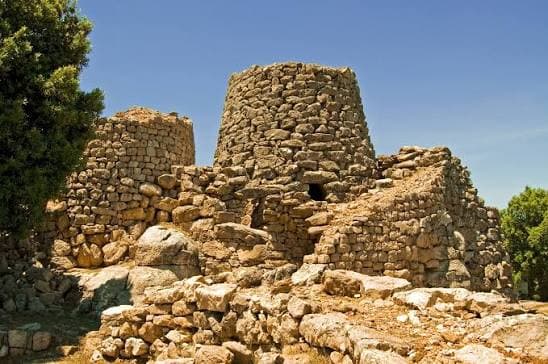
The perfect place to get to know the nuragic civilisation is 19 minutes from the villa, above Ilbono. The Scerì archaeological site brings together, among granite outcrops and olive trees, a well-preserved nuraghe built on a rocky spur, the remains of the village, and two domus de janas — "fairy houses" carved into the rock in the Neolithic era, millennia before the nuraghi themselves.
It's a compact, well-kept site, great for kids too: you can visit it at an easy pace in a couple of hours, and it's the best way to add depth to all the other ancient stones you'll come across around the island. Visits are run by a local cooperative with a guided tour: I'd recommend checking opening times and availability before you go (tel. 0782 41051).
Rocce Rosse in Arbatax: the symbol of coastal Ogliastra
There are few places in Sardinia where the rock rises from the sea quite like this: the Rocce Rosse of Arbatax, 25 minutes from the villa, are spires of red porphyry mirrored in clear water over a pale granite seabed. They're a natural monument and the symbol of coastal Ogliastra — so much so that Poste Italiane dedicated a stamp to them in 2007, and the final scene of Lina Wertmüller's Swept Away was filmed right here.
Access is free, just steps from Arbatax harbour. The best time is sunset or early evening, when the rock turns red: in summer the square among the rocks hosts concerts and festivals. Pair it with a day at the beaches of Tortolì and the surrounding area — you'll find them in the beaches guide.
Monte Armidda Observatory: the stars like you've never seen them
30 minutes from the villa, above Lanusei at around 1,150 metres, you'll find the "Ferdinando Caliumi" Astronomical Observatory on Monte Armidda, run by the Associazione Ogliastrina di Astronomia. Light pollution here is almost non-existent: inland Ogliastra's night sky is among the darkest in Italy, and looking at Saturn or a nebula through the observatory's 400 mm telescope is an experience you won't forget.
- Open: Mondays and Fridays (non-holidays) from 9pm, in summer also Wednesdays on request.
- Booking is mandatory and must be made in advance: tel. +39 380 3688198, astroaoa@tiscali.it. Info at astroarmidda.it.
- My tip: bring a jumper even in August — it gets cool in the evening at 1,150 metres — and plan your visit around new moon nights, when the sky is darkest.
Scala di San Giorgio: the gorge cut into the rock at Osini
30 minutes from the villa, above Osini, the road passes through the mountain: the Scala di San Giorgio is a narrow gorge between rock walls around fifty metres high, a natural monument since 1994. Legend has it that it was miraculously opened for the passage of San Giorgio, the first bishop of this land around the year 1000; geology points to a fissure in the "tacchi", the limestone and dolomite plateaus that dominate inland Ogliastra.
You can drive through it with no difficulty at all — the drive alone is worth the detour — but the best way to experience it is to continue on the plateau up to the Serbissi nuraghe, one of the best preserved in Sardinia, at around 1,000 metres with a 360-degree panorama: route and details in the Ogliastra hiking guide. Along the way, the ruins of Osini Vecchio, the village abandoned after the 1951 flood, are also worth a look.
And then: caves, canyons and crags
Three highlights of inland Ogliastra already have their own dedicated guide on this site:
- Su Marmuri cave — one of the largest caves in Europe, 20 minutes from the villa: opening times, prices and tips in the article.
- Trekking in Ogliastra — from the Gola di Gorropu, Italy's deepest canyon, to the Selvaggio Blu, with the Komoot routes I use myself.
- Climbing in Ogliastra — the crags of Jerzu, Ulassai and Osini, minutes from home.
How to plan it: the advantage of staying centrally
The great thing about Ogliastra is that it's compact: from Pelau, where Villa Pelau is located, every place in this article is within half an hour's drive, and the sea stays just 10-15 minutes away. The rhythm I recommend to my guests is simple: sea in the morning, when the light is best; inland in the afternoon, when the beaches get crowded; and at least one evening at the Rocce Rosse or the observatory. A week goes by fast — and usually isn't enough.
Frequently asked questions
What can you do in Ogliastra when it's not beach weather?+
The inland offers plenty of alternatives: the Su Marmuri cave (constant temperature all year round), the Stazione dell'Arte in Ulassai, the Scerì archaeological site and the villages. None of these depend on the coastal weather.
How far are these places from Villa Pelau?+
Everything in this article is 19-30 minutes by car from Pelau: Ogliastra is small but varied, and the villa's location is central to both the coast and the inland.
Do you need to book to visit these places?+
Booking is mandatory for the Monte Armidda Observatory; for Scerì and the Su Marmuri cave it's best to check opening times and slots, especially in high season. Rocce Rosse and the Scala di San Giorgio are freely accessible.
Is Ogliastra worth visiting outside summer?+
Yes: spring and autumn are ideal for hiking, climbing and cultural visits, with mild temperatures and very few people. Many of these places are actually at their best outside the summer months.

Roberto Demurtas
Host of Villa Pelau
Sono nato e cresciuto in Ogliastra. Con Villa Pelau accolgo chi vuole scoprire questa terra, e in questa guida racconto i posti che frequento da sempre.
Sleep just minutes away
Villa Pelau sits among the vineyards of Jerzu, just minutes away: a fenced garden, private jacuzzi, and the perfect base to experience Ogliastra like a local.
Discover Villa Pelau